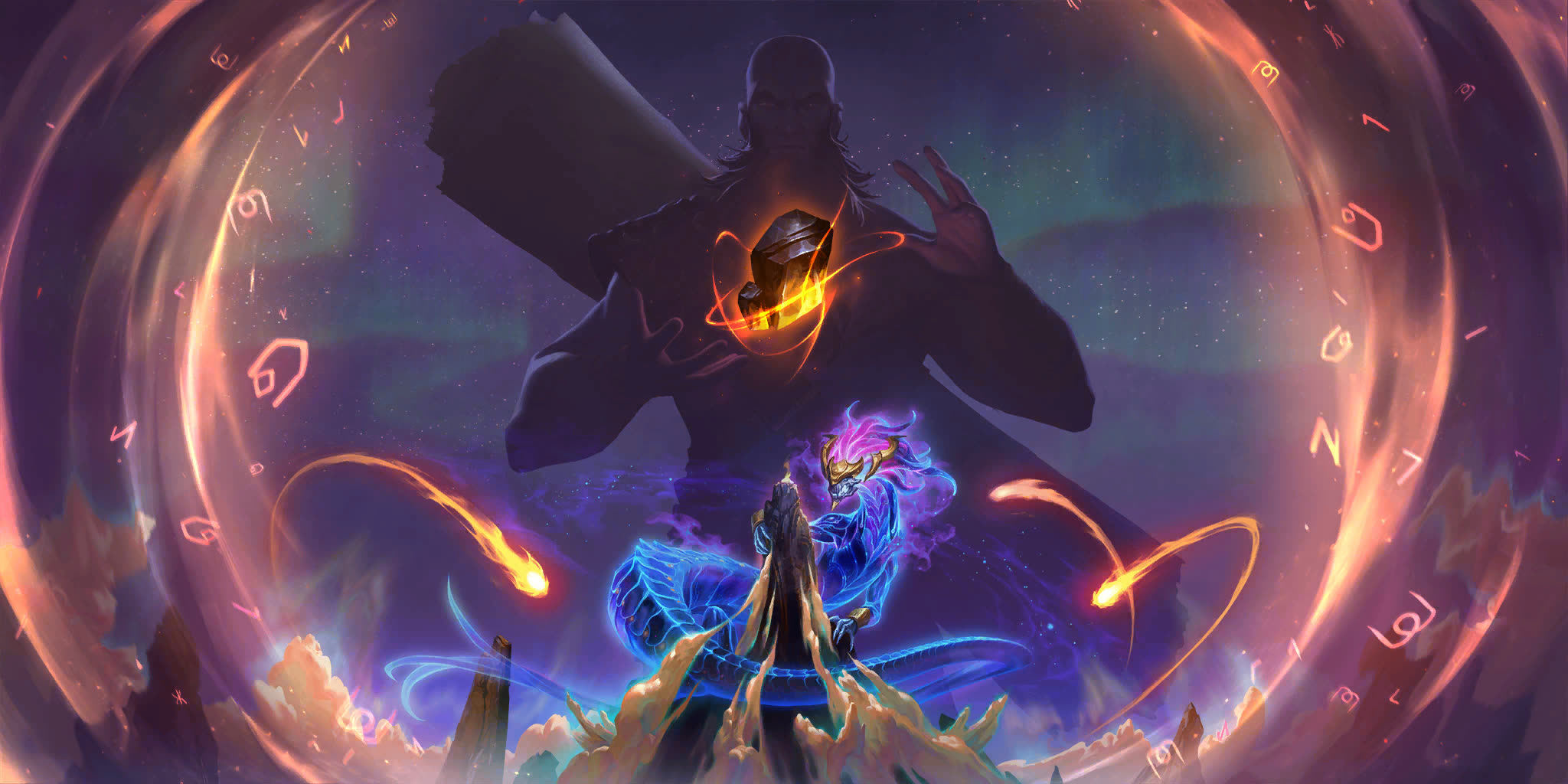
Riot has confirmed that Deathfire Touch and Stormraider's Surge will return to League of Legends in Patch 26.9, expected around April 29, 2026. Both runes were removed during the Preseason 2018 overhaul (Patch 7.22) when the old Keystone Mastery system was replaced by the current rune paths. That was over eight years ago. An entire generation of League players has never used either of these runes in a live game.
Their return matters because they fill niches that the current rune system does not fully cover. Deathfire Touch rewarded sustained damage-over-time in a way that no existing keystone replicates. Stormraider's Surge gave burst-heavy champions a movement speed payoff for landing their combo, something Phase Rush approximates but does not quite match. If these runes return in any form resembling their originals, they will reshape how you build on dozens of champions.
Exact numbers and mechanics for the 2026 versions have not been officially confirmed yet. This guide covers what the original runes did, which champions and items are best positioned to use them, and practical steps you can take right now to be ready when Patch 26.9 drops.
What Was Deathfire Touch?
Deathfire Touch (DFT) was a Keystone Mastery in the Ferocity tree. Its mechanic was simple: when you dealt ability damage to an enemy champion, you applied a damage-over-time burn. The burn scaled with your bonus AD and AP, and its duration depended on the type of ability that triggered it.
Original Deathfire Touch (Patch 7.22):
Single-target abilities: burned for 4 seconds
Area-of-effect abilities: burned for 2 seconds
DOT abilities: burned for 1 second (but reapplied with each tick)
Damage per second: (0.5 + 0.167 bonus AD + 0.1 AP) magic damage
The critical detail was how DFT interacted with damage-over-time abilities. Champions like Brand, Malzahar, and Teemo could continuously reapply the burn through their own DOT effects, creating a stacking pain loop that added meaningful damage over extended fights. A Brand with Liandry's Torment and DFT in 2017 could apply three separate sources of burn simultaneously: his passive Blaze, Liandry's, and Deathfire Touch.
DFT also found a second home on poke-heavy AD carries. Jhin and Caitlyn used it because their long-range abilities could proc the burn without needing to commit to a trade. Unlike Thunderlord's Decree (which required three separate hits), DFT activated on a single ability hit. For champions who wanted to whittle opponents down from range, that single-proc activation was the selling point.
Why DFT Was Removed
When Riot overhauled the rune system in Preseason 2018, DFT did not have a direct successor. Arcane Comet occupies a loosely similar "poke mage keystone" space, but Comet is a skillshot that deals its damage in a single hit rather than as a burn. The sustained DOT niche that DFT filled has been empty ever since. That gap is exactly why its return is significant.
Best Champions for Deathfire Touch
If Deathfire Touch returns with mechanics similar to the original, these champions stand to benefit the most. We are grouping them by the reason they synergize with the rune.
DOT Mages - The Primary Beneficiaries
Champions with built-in damage-over-time effects will get the most out of DFT because they naturally reapply it through their kit. Every tick of their DOT refreshes the Deathfire burn, turning a small per-second value into significant cumulative damage over a fight.
- Brand - The obvious number one. His passive Blaze already burns enemies for 4 seconds. With DFT, Brand would apply his passive burn, Liandry's burn, and DFT burn simultaneously. In the old system, Brand was the single highest-damage DFT user in the game, and there is no reason to expect that to change.
- Malzahar - Malefic Visions (E) jumps between targets and burns for 4 seconds per target. His Void Swarm (W) voidlings also proc on-hit effects when attacking marked targets. Malzahar + DFT means anyone standing in a minion wave with Malefic Visions spreading through it takes relentless chip damage.
- Zyra - Her plants count as separate damage instances and continuously reapply effects. Every plant auto-attack would refresh DFT, which means a well-placed Zyra combo with two or three plants active would keep the burn ticking for the entire duration of the fight.
- Teemo - Noxious Trap (R) shrooms deal damage over time and would each apply and maintain DFT on anyone who walks through them. An enemy stepping on a shroom while Teemo is not even nearby would still eat the full DFT burn.
- Singed - Poison Trail (Q) continuously applies ability damage, which means DFT would be permanently active on anyone chasing Singed through his poison. This was a real synergy in the old system and made Singed's proxy farming even more punishing to deal with.
Poke ADCs and Long-Range Carries
For AD carries who trade with abilities rather than auto-attacks, DFT historically outperformed other keystones because it only required a single ability hit.
- Jhin - Dancing Grenade (Q) and Deadly Flourish (W) are long-range abilities that easily proc DFT. Jhin rarely wants to auto-attack in lane trades at early levels, so a keystone that rewards single ability hits fits his playstyle perfectly. He was the highest pick-rate DFT ADC in the old system.
- Caitlyn - Piltover Peacemaker (Q) through the minion wave applies DFT to anyone it passes through. Combined with her traps and long auto-attack range, Caitlyn can apply consistent poke that slowly grinds opponents out of lane.
- Miss Fortune - Make It Rain (E) and Double Up (Q) both apply DFT. MF historically used DFT as a laning-phase tool because her Q bounce into an enemy champion was one of the easiest DFT procs in the game.
- Ezreal - Mystic Shot (Q) is spammable poke that would proc DFT on every hit. While Ezreal has strong alternatives in the current rune system, DFT would give him another option for poke-focused builds.
Item Synergies with Deathfire Touch
The items that synergize best with DFT are the ones that also deal or amplify burn damage. If DFT returns, expect these items to spike in priority:
- Liandry's Torment - The defining DFT synergy item. Liandry's burn plus DFT burn creates two simultaneous DOT effects from a single ability hit. On DOT mages, you could have three burns stacking at once (champion passive + Liandry's + DFT). This combination was the cornerstone of Brand, Malzahar, and Zyra builds for two full seasons.
- Blackfire Torch - The current iteration of the burn mage mythic. If DFT returns, Blackfire Torch could overtake other options on champions who can keep the burn permanently applied, since its damage amplification passive rewards extended combat.
- Demonic Embrace - Applies a max-HP burn on ability damage. Stacking Demonic's burn with DFT creates yet another layer of damage over time. On tankier AP champions like Singed, Mordekaiser, or Swain, the Demonic + DFT combination could make them extremely threatening in extended fights.
- Rylai's Crystal Scepter - Does not burn, but slows enemies caught in your DOTs, keeping them in range of your DFT burn longer. Rylai's + Liandry's + DFT was the classic "pain train" build on Brand support in 2017, and that triangle of items would likely reassemble immediately.
Start practicing Brand, Malzahar, or Zyra now if you do not already play them. These champions are strong in the current patch, and if DFT returns with similar mechanics, they will only get stronger. Having 20+ games of experience before the patch drops puts you ahead of everyone scrambling to learn on day one.
What Was Stormraider's Surge?
Stormraider's Surge was a Keystone Mastery in the Cunning tree. Unlike most keystones, it did not deal any damage. Instead, it rewarded you for dealing damage by giving you a powerful burst of movement speed.
Original Stormraider's Surge (Patch 7.22):
Trigger condition: Deal 30% of a champion's max HP within 2.5 seconds
Reward: 40% bonus movement speed + 75% slow resistance for 3 seconds
Cooldown: 10 seconds per target
The key difference between Stormraider's Surge and its successor Phase Rush is the trigger condition. Phase Rush activates when you hit an enemy champion with 3 separate attacks or abilities within 4 seconds. Stormraider's activated when you dealt enough damage in a single burst. That distinction matters enormously for certain champion archetypes.
A champion like Darius who lands a single massive Noxian Guillotine (R) on a low-HP target easily hits the 30% max HP threshold with one ability. Under the current Phase Rush, Darius needs to land three separate hits first. Stormraider's rewarded the quality of your damage. Phase Rush rewards the quantity of your hits. These are fundamentally different triggers that favor different champions.
Stormraider's vs. Phase Rush - The Real Difference
Phase Rush was marketed as Stormraider's replacement, and for some champions the transition was seamless. Cassiopeia, Ryze, and Viktor easily land three separate hits in quick succession, so Phase Rush works just as well for them. But for champions who deal their damage in one or two large hits, the switch to Phase Rush was a significant downgrade.
Assassins like Zed and Talon dump their combo in 1-2 abilities. Stormraider's triggered instantly on that burst. Phase Rush requires them to weave in extra hits to get three procs, which costs precious time and can mean the difference between escaping after a kill or dying to the collapse. If Stormraider's returns, these burst-heavy champions get their escape tool back.
Best Champions for Stormraider's Surge
If Stormraider's Surge returns with a similar burst-threshold trigger, these champions are the ones who historically used it best, and who would most benefit from having it available again.
Burst Mages
- Viktor - Chaos Storm (R) + Siphon Power (Q) + Death Ray (E) easily reaches the 30% HP threshold in under a second. Viktor was one of the most common Stormraider's users because the movement speed let him reposition to land the second tick of his ultimate. He currently uses Phase Rush, but Stormraider's fits his all-in pattern better.
- Ekko - Parallel Convergence (W) + E + Q combo deals heavy burst damage. Stormraider's gave Ekko the speed to position for his Chronobreak (R) return or to chase down targets after his initial burst. The movement speed layered on top of his already mobile kit made him extremely slippery.
- Syndra - Unleashed Power (R) alone can hit the 30% threshold on squishier targets. With Stormraider's, Syndra could ult a carry and immediately reposition to safety without needing Flash.
- Veigar - Primordial Burst (R) scales infinitely and frequently deals 30%+ of a target's max HP in a single cast. Stormraider's gave Veigar, one of the least mobile mages in the game, a way to actually move after landing his combo.
Assassins
- Zed - Living Shadow (W) + Shuriken (Q) + Shadow Slash (E) + auto-attack delivers burst damage well above the 30% threshold. The movement speed from Stormraider's was Zed's primary escape tool after committing his W for the engage. Without it, Zed has had to rely on Electrocute for damage or Conqueror for sustain, neither of which helps him get out.
- Talon - Noxian Diplomacy (Q) + Rake (W) + passive bleed frequently hits the threshold in two abilities. Stormraider's let Talon all-in, kill, and wall-hop away with bonus speed. It was his most popular keystone before removal.
- Kha'Zix - Isolated Taste Their Fear (Q) deals massive single-target damage. On an isolated target, a single Q + auto often crossed the 30% threshold. Stormraider's gave Kha'Zix repositioning speed to find the next isolated target in a teamfight.
Bruisers and Juggernauts
This is the category where Stormraider's Surge had its most transformative impact. Juggernauts are defined by their high damage and low mobility. Stormraider's directly addressed their biggest weakness.
- Darius - The poster champion for Stormraider's Surge. A Darius who lands Noxian Guillotine on a target below 50% HP almost always triggers the threshold. The 40% movement speed + 75% slow resistance meant Darius could dunk one target and immediately sprint to the next. In the old system, Stormraider's Darius had noticeably higher win rates than any other keystone on him. He currently uses Ghost + Phase Rush to approximate this effect, but Stormraider's did it with one rune slot instead of two.
- Illaoi - Leap of the God (R) in a group of enemies easily surpasses the 30% threshold. Stormraider's gave Illaoi the speed to chase targets trying to walk out of her tentacle zone. Without it, enemies simply walk away from her ultimate, which is her primary frustration point in the current meta.
- Nasus - A stacked Siphoning Strike (Q) hitting a squishy champion deals massive damage. Stormraider's solved Nasus's eternal problem: he deals enormous damage but cannot reach anyone. The movement speed from a big Q let him stick to his target for the follow-up hits. Ghost + Stormraider's Nasus was one of the most terrifying late-game combinations in the old system.
- Mordekaiser - His combo deals high burst in a small window. Stormraider's gave Mordekaiser the gap-close he needs to land his full damage rotation. Currently he uses Conqueror, but Stormraider's would give him a completely different playstyle focused on burst-and-run rather than sustained combat.
Item Synergies with Stormraider's Surge
Stormraider's does not care about damage type or build path. It only cares that you deal enough damage fast enough. That said, certain items make it easier to hit the 30% threshold:
- Lethality items (Youmuu's Ghostblade, Hubris, Opportunity) - Flat armor penetration increases your burst damage against squishies, making it easier to hit the 30% HP threshold on carries. Youmuu's is especially interesting because its active movement speed stacks with Stormraider's for extreme chase potential.
- Trinity Force - Spellblade proc on a bruiser like Darius or Nasus adds a burst of damage after using an ability. This extra burst can be the difference between hitting and missing the 30% threshold on tankier targets.
- Dead Man's Plate - Movement speed stacking. If you trigger Stormraider's while your Dead Man's stacks are charged, you combine the burst of speed from both sources to become nearly uncatchable.
- Hextech Rocketbelt - The dash + damage from Rocketbelt can contribute toward the 30% threshold while simultaneously closing the gap. On AP assassins like Ekko, this item + Stormraider's creates a hyper-mobile burst pattern.
If you play Darius, Nasus, or Illaoi, start tracking how much damage your combo does relative to the enemy's max HP. Get a feel for when you cross the 30% threshold. In the current patch, you can practice this by watching the damage numbers: if your full combo on a target with 2000 HP deals 600+, you would have triggered Stormraider's. Building that awareness now means you will instinctively know when the speed boost is about to activate once the rune is live.
How Will These Runes Change Your Build?
Both runes have the potential to shift item priorities on the champions that use them. Here is what to watch for.
DFT Champions May Shift Away from Burst Keystones
Champions like Brand and Malzahar currently run Dark Harvest or Arcane Comet as their primary keystone. If DFT returns with comparable damage output, the calculus changes. DFT rewards sustained trades and teamfight presence, while Dark Harvest rewards executing low-HP targets. For DOT mages who excel at prolonged fights, DFT could become the mathematically superior option in most game states.
This also means their item builds may shift toward more sustained-damage profiles. If you are already running DFT for extended fight damage, you do not need burst from your items. Liandry's + Rylai's + Demonic Embrace becomes the natural three-item core because every component amplifies the sustained damage pattern that DFT rewards.
Stormraider's Champions May Drop Ghost
Darius, Nasus, and other juggernauts currently take Ghost as a summoner spell specifically to solve their mobility problem. If Stormraider's Surge returns and fills that role through the rune system, these champions could swap Ghost for Teleport, Ignite, or Exhaust. That is a significant power shift. A Darius with Flash + Ignite + Stormraider's has kill pressure that Flash + Ghost + Phase Rush Darius does not.
On the item side, champions who currently build movement speed items to compensate for their lack of mobility (Dead Man's Plate, Force of Nature, Swifties) might be able to drop those in favor of more damage or tankiness. When your rune gives you conditional 40% movement speed, you do not need to spend 2800 gold on Dead Man's Plate to get a similar effect.
Rune Diversity Opens New Playstyles
The most exciting implication is that adding two keystones expands the number of viable build paths. A champion like Ekko currently chooses between Electrocute (burst), Conqueror (sustained), and Dark Harvest (snowball). Adding Stormraider's Surge gives him a fourth option: burst combo into reposition. That is not just a different rune; it is a different way to play the champion.
Similarly, Teemo choosing between Aery (poke), Grasp (tank), and PTA (on-hit) would gain DFT as a dedicated DOT option. Teemo builds have been diversifying all season, and DFT could cement the AP burn path as the dominant build if its numbers are competitive.
Preparing for Patch 26.9
You have roughly two weeks before these runes go live. Here is a concrete checklist to prepare.
For Deathfire Touch
- Pick up a DOT mage if you do not play one. Brand support has a low skill floor and will likely be one of the biggest DFT beneficiaries. You can learn him to a competent level in 10-15 games.
- Practice the Liandry's rush build path. Learn the component timings: Lost Chapter (1300g) into Liandry's completion (3000g). If DFT returns, this will be the default first item on nearly every DFT user.
- Learn to track burn damage. With DFT, a meaningful percentage of your total damage comes from DOTs that tick after the fight ends. Get comfortable with enemies dying to burns three seconds after you stop pressing buttons.
For Stormraider's Surge
- Practice burst combos on Darius, Nasus, or your preferred juggernaut. Stormraider's is useless if you cannot hit the damage threshold. Work on landing full combos reliably.
- Experiment with dropping Ghost. Try Flash + Teleport or Flash + Ignite on juggernauts in your current games. See how it feels to play without Ghost. If you find yourself needing the speed only in specific moments (post-kill resets, chasing after a trade), that is exactly the pattern Stormraider's covers.
- Study the 30% HP breakpoints. At level 6, a typical ADC has around 1000 HP. 30% of that is 300 damage. A Darius W + auto + passive stack does roughly that much. At level 11 against a target with 1600 HP, you need 480 damage. Know your numbers before the rune goes live.
Important note: Riot has not released the exact numbers for the 2026 versions of these runes. The mechanics described above are from the original 2017 versions. The returning runes may have adjusted numbers, different scaling, or modified trigger conditions. We will update this guide with confirmed stats as soon as Patch 26.9 hits PBE.
What This Means for the Meta
Zooming out, adding two keystones to the rune system has ripple effects beyond just the champions who use them. If DFT makes DOT mages significantly stronger, you will see more of them in solo queue, which means their counters (long-range burst mages, assassins who can kill before the burn accumulates) also become more valuable. If Stormraider's makes juggernauts more mobile, ranged top laners and disengage supports become more important as answers.
The biggest meta question is whether these runes coexist with their spiritual successors or replace them. If Stormraider's Surge exists alongside Phase Rush, champions who can use either one get a genuine strategic choice in champ select. If it replaces Phase Rush entirely, champions like Cassiopeia and Ryze who rely on Phase Rush's multi-hit trigger would need to adapt.
We will know more once Patch 26.9 hits PBE. Until then, the best use of your time is getting comfortable with the champions who are most likely to benefit. The players who climb the fastest after a major rune change are never the ones who wait to figure it out on live. They are the ones who already know the champion and only need to learn the rune.
Adapt Your Builds in Real Time
When Patch 26.9 drops, Hexgate will update its item recommendations to account for the new runes. Get data-backed builds for every matchup, automatically.
Download Hexgate - Free