
Short answer: when a ranked game loads, Hexgate Pro+ looks up your lane opponents and the enemy jungler in up to 12 of their most recent ranked games in the role they are playing now. A card on the loading screen lists their early-game habits with the count behind each one: where the jungler starts, which lane he ganks, whether your lane opponent dies early or roams. It stays until 1:30 and comes back when you hold Tab.
This guide shows what the card looks at, with real examples from ranked players, and how to turn it into decisions in the first three minutes. If you only want to see it, the homepage has examples for every role.
Why the Loading Screen Is the Right Moment
The first three minutes of a game are decided before anyone has an item. Whether you ward the river bush at 1:20 or 2:45, whether you leash or hold your lane for level 1, whether you push for level 2 or wait: every one of those choices depends on what the enemy is likely to do, and every one is made before you have seen them do anything.
Players do exist in patterns. A jungler who started on the same buff in 11 of his last 12 games will probably do it again. A mid laner who left lane twice a game toward bot will probably do that too. None of this is secret; it is in their match history. The problem is that nobody opens five profiles and reads twelve timelines each on a loading screen. That part Hexgate does for you.
What the Card Shows
The card lists the players who matter for your lane, each with a champion icon, the role they are playing and how many ranked games were read. Under each player are up to three lines, strongest first. Lines that concern your own lane get a gold marker, so your eye goes there first.
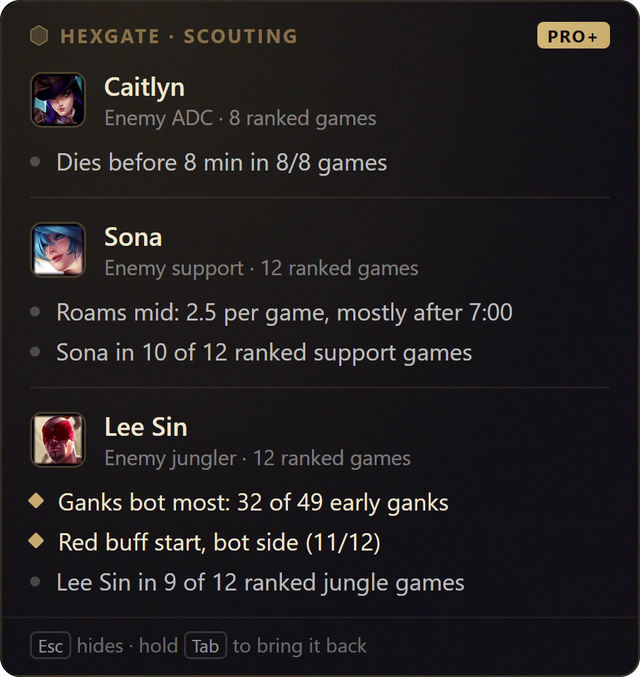
In the example above you are the ADC. The enemy Caitlyn has died before 8 minutes in every one of her last 8 ranked games. The enemy Sona leaves lane for mid about 2.5 times a game, mostly after 7:00. And the enemy Lee Sin starts red buff on the bot side in 11 of 12 games and ganks bot more than any other lane: 32 of his 49 early ganks. That is a very specific first three minutes. Expect Lee Sin bot around his first clear, ward for it, and do not take a risky trade at level 3 without knowing where he is.
The Enemy Jungler
The jungler is the player who decides most early deaths, so the card reads his games for four habits:
- Start side. Which buff he starts on and which side of the map that is for his team. Together with his first gank, it tells you where he is likely to be around 3:00.
- Level 1 invades. How often he is in your jungle when camps spawn, which decides whether your team should leash or stay together.
- First gank. The lane of his first takedown or death before 6:00, and the median minute it happens.
- The lane he ganks most. Every kill, assist and death in a lane before 10:00, counted per lane.
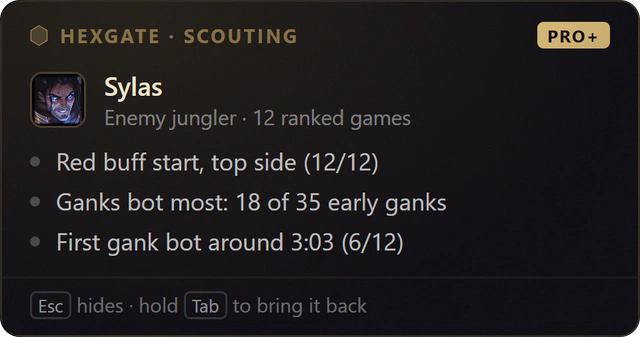
If you play jungle, you always see the enemy jungler. If you play a lane, you only see him when his habits concern you: he ganks your lane most, he first-ganks it, or he invades level 1 (which matters to every lane). A jungler who lives in top lane is not worth a line on a bot laner's card, so he is left out.
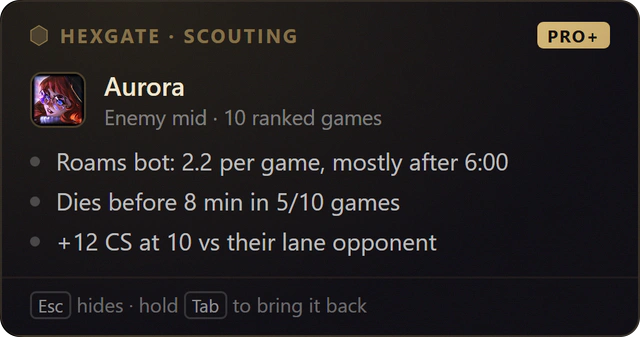
The same rule applies to the enemy mid laner. If you play top or bot and he roams to your lane in most of his games, he joins your card with that roam line first and marked for your lane. A mid who stays in lane, or roams to the other side, is left out.
Your Lane Opponent
For the players in your lane, the card looks at how their early game usually goes:
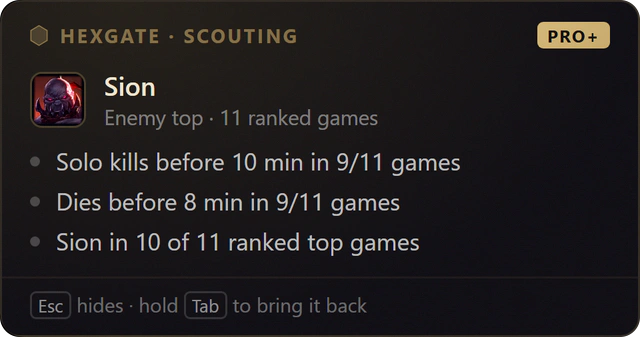
- Early solo kills before 10:00. A player who gets them in most games plays for kills; respect their level 2 and level 6.
- Early deaths before 8:00. A player who dies early in most games overextends, which is exactly what your jungler wants to know.
- CS at 10 against their own lane opponent, on average. A big plus means a strong laner; a big minus means one you can pressure.
- Roams for mids and supports: how often they leave lane between 3:00 and 14:00, and to which side.
- Teleport plays for top laners: how often they join a fight in bot lane before 14:00.
Bot lane is bloodier than the rest of the map: early deaths and level 2 or 3 fights happen in most bot lane games for everyone. So in bot lane those two lines need 80 percent of games before they appear, instead of half. A Caitlyn who died early in 8 of 8 games gets a line; one who died early in 5 of 8 does not.
Lane Scouting is part of Pro+. €9.99 a month, or €7.49 a month billed annually, with everything in Pro and the Match Breakdown included. Already on Pro? Switch plans from the billing portal in the app. See Pro+ pricing.
How to Use It in the First Three Minutes
- Ward for his path. Put the start side, the first gank and the lane he ganks most together. A jungler who starts on your side and ganks your lane most can be there around level 3, so your first ward goes down before 3:00, on his side of the river.
- Decide the leash. If the enemy jungler invades level 1 in a good share of his games, keep your team together at 1:00 instead of splitting to leash.
- Pick your fights by the lines. A lane opponent who dies early in most games is someone to pressure; one with early solo kills in most games is someone to respect at level 2 and 6.
- Track the roamer. If the enemy mid roams bot about twice a game after 6:00, your bot lane can play around it before it happens. Ping it at the start of the game.
- Read the count, not just the line. 12/12 is a habit. 4/7 is a tendency. The card shows the count so you can weigh it.
When Nothing Is Shown
The card only shows what the games support. That is why some games show three players and some show one or none:
- A player needs at least 4 ranked games in the role they are playing now, within their last 40 games. A support who fills jungle is judged on their jungle games only, and if they have none, they are left out.
- A habit needs to reach its bar before it becomes a line. A player with no line above the bars is not shown at all. There is never a "not enough data" message.
- Players who hide their name are skipped, and their games are never read.
- Only ranked Solo/Duo and Flex games are scouted, and only ranked games are read.
When It Shows, and How to Get It Back
Ranked champion select hides the enemy team, so scouting starts the moment the game begins to load. Reading the games takes a few seconds, and a player scouted in the last hour is instant. The card then stays on screen until 1:30 in game, when camps have spawned and the start-side information has done its job. Press Escape to hide it earlier.
After that, hold Tab. The card comes back next to Hexgate's build overlay for as long as Tab is held, and you can drag it anywhere on screen while holding Tab. It remembers the spot. If you open Hexgate after the game has already started, it scouts the enemy team right away and the card waits for Tab.
What It Costs
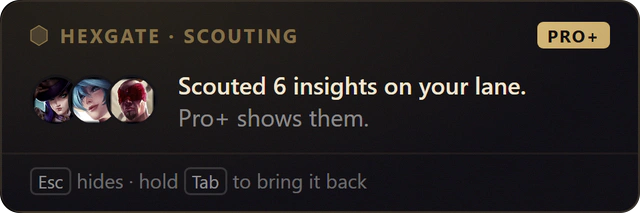
Lane Scouting is part of Hexgate Pro+: €9.99 a month, or €7.49 a month billed annually. Pro+ also includes the post-game Match Breakdown and everything in Pro (unlimited games, lane matchup scoring, OTP builds). Free and Pro players get a one-line preview on the loading screen that says how many insights were found for their lane:
Frequently Asked Questions
Is Lane Scouting allowed by Riot?
Yes. It uses the match history your own League client already offers for any player, the same games you see when you open someone's profile. Nothing happens during champion select, where ranked hides the enemy team. Hexgate does not modify game files, read game memory or automate anything, and it works within Riot's third-party tool rules.
Does the card show player names?
No. The card only shows champions. Players who hide their name are skipped entirely, so their games are never read.
Which games does it work in?
Ranked Solo/Duo and Flex. It reads each player's ranked games in the role they are playing now, so a support who fills jungle is judged on their jungle games only.
How reliable are the numbers?
Every line shows its count, like 11/12, so you can see how strong the habit is. A player needs at least 4 ranked games in the role before anything is shown, and a habit has to reach a share of games before it gets a line: half the games for events like early deaths, 80 percent in bot lane where early fights happen in most games.
Know Your Lane Before It Starts
Hexgate scouts your lane when the game loads, builds against the enemy team during it and, with the Match Breakdown, explains the result after it. Install free, then upgrade to Pro+ in the app.
Get Hexgate Pro+Download Hexgate free (3 games a day, no ads) · see examples for every role