Short answer: after every ranked game, Hexgate Pro+ builds a Match Breakdown from the game's own timeline. It opens from your match history and says, in plain sentences, what hurt and what helped, with the numbers behind each call. It uses AI to decide which signals mattered; every sentence it shows is a fact from your game.
This guide walks through what a breakdown looks at, using two real games: a Master Yi jungle win with one leak in it, and a Pantheon support loss where three things went wrong. If you only want to see the thing, the homepage has a live example.
Why the Scoreboard Is Not Enough
You finish a game 19/4/2 and win, so you assume it was clean. You finish 13/10/20 and lose, so you assume the deaths did it. Both assumptions are sometimes right. Neither is checkable from the post-game screen, because the post-game screen is a total: it adds up the whole game into a handful of numbers and throws away the order in which things happened.
The order is where the answer lives. A death at minute 8, caught alone in the enemy jungle, is a different event from a death at minute 29 while your team takes Baron. Three deaths in the eight minutes after your lead peaked are a throw; three deaths spread across a 39-minute game are Tuesday. A Baron that turns into five buildings won the game; a Baron that turns into zero buildings was a 35-second waste of a numbers advantage. The timeline knows all of this. The scoreboard does not.
What a Breakdown Looks At
A breakdown starts with the verdict: one line that says how the game went and whether the result was mostly on you, on your team, or shared. Under it are cards in two groups, what hurt and what helped. Each card is one thing that changed the result, with the evidence in the second line.
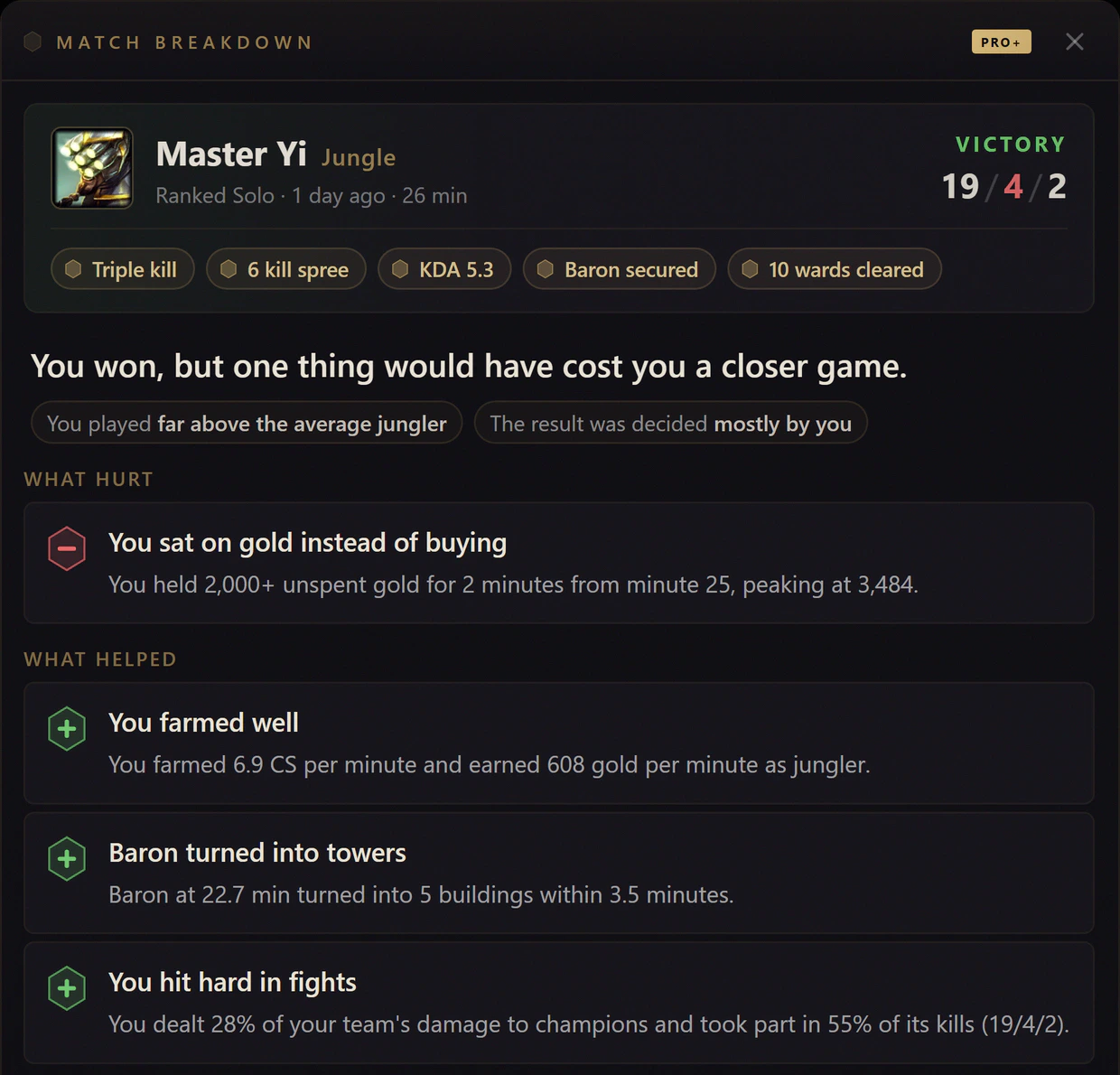
In the Yi game above, the verdict is "You won, but one thing would have cost you a closer game." The one thing: 2,000+ unspent gold held for two minutes from minute 25, peaking at 3,484. That is an item and a half sitting in the shop while the game was being decided. The three helped cards are the reason the leak did not matter: 6.9 CS per minute and 608 gold per minute as a jungler, a Baron at 22.7 minutes that turned into five buildings within 3.5 minutes, and 28 percent of the team's damage with a hand in 55 percent of its kills.
Notice what is not there. No "improve your vision" card, even though a jungler placing zero control wards is easy to flag. In a 26-minute stomp with 10 wards cleared, vision did not decide anything, so it does not get a card. That restraint is the point: a list of twenty tips is a list you stop reading after the second game.
Judged for Your Role
A support who gets told to farm more has been given advice for a different job. Each breakdown judges the game against what your role is supposed to do: ganks and objectives for junglers, vision and roams for supports, the lane matchup and tower pressure for laners, damage and fight timing for carries. The benchmarks come from what players in that role actually do, not from a single number applied to everyone.
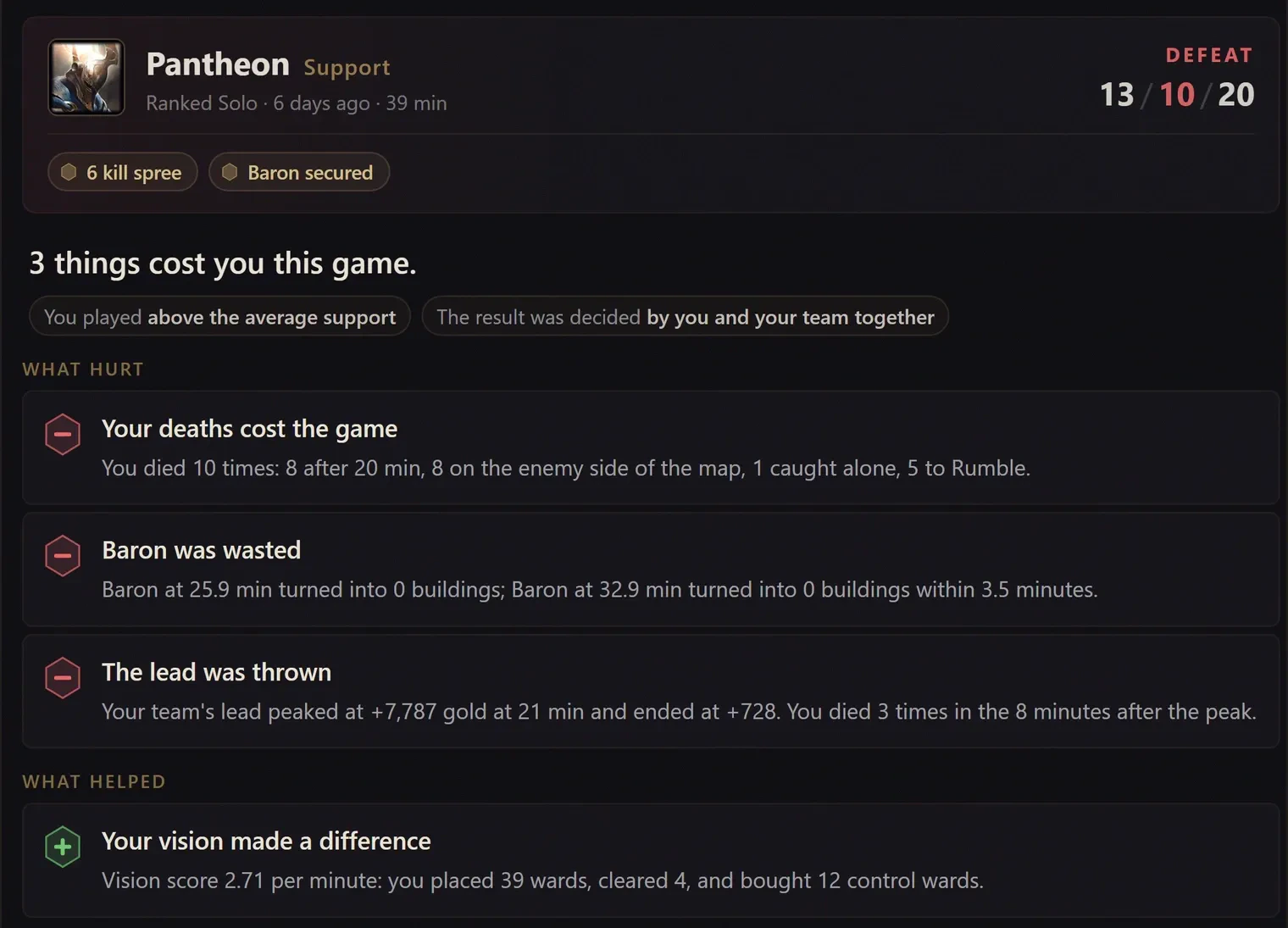
The Pantheon support loss shows the other side. "3 things cost you this game": ten deaths, eight of them after minute 20 and eight on the enemy side of the map, with five to Rumble alone; two Barons that turned into zero buildings; and a lead of 7,787 gold at minute 21 that ended at 728, with three of the deaths in the eight minutes after the peak. The one helped card is vision, 39 wards placed and 12 control wards bought, because for a support that is the job, and it was done well.
Same tool, opposite verdict, and the difference is not the KDA. It is where the deaths happened, when they happened, and what the team did with the numbers advantages it earned.
Pro+ does this for every ranked game you play. €9.99 a month, or €7.49 a month billed annually, with everything in Pro included. Already on Pro? Switch plans from the billing portal in the app. See Pro+ pricing.
Your Kills and Deaths on the Gold Curve
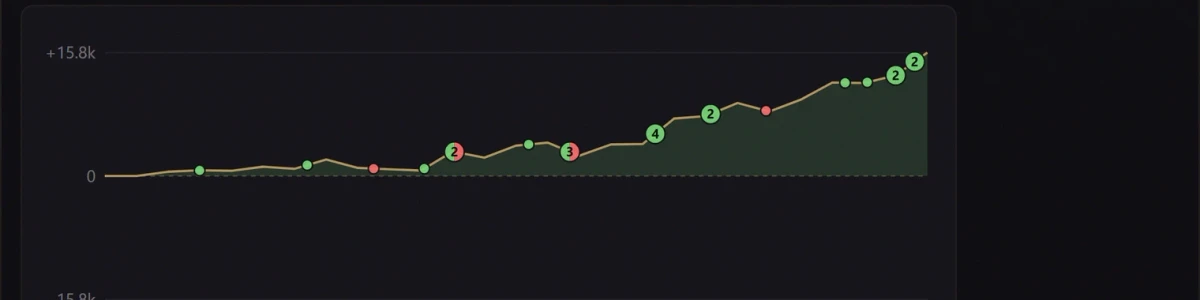
Under the cards sits the team gold curve with every one of your kills and deaths on it. Hover a marker to see the minute, who was involved and whether you were caught alone. When the curve peaks and then bleeds out with three red dots in a row, you are looking at the throw, not reading about it.
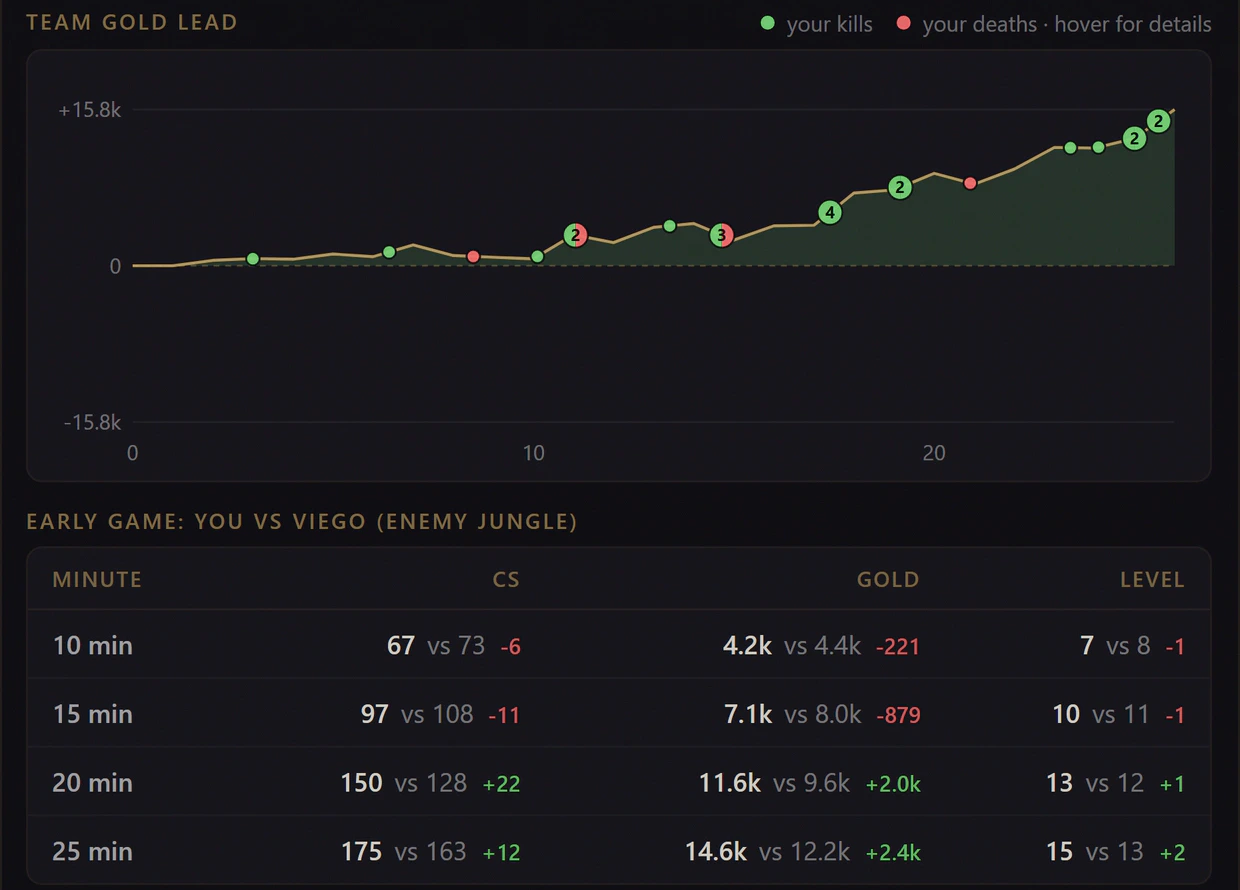
Next to the curve is the early game against your lane opponent (for junglers, the enemy jungler): CS, gold and level at 10, 15, 20 and 25 minutes. Yi was down 6 CS and 221 gold at 10 minutes and up 22 CS and 2,000 gold at 20. That is the shape of a jungler who lost the early tempo and won the mid game, and it is exactly the shape you would want to know about if the game had gone the other way.
Fights, Objectives, Deaths
The part of the game the scoreboard never records: how many team fights happened, how many you were in, and how they went with and without you. Which dragons, Barons and Heralds your team took while you were there, and which ones fell while you were dead or on the other side of the map. How long you spent dead in total, and what share of your team's kills you had a hand in.
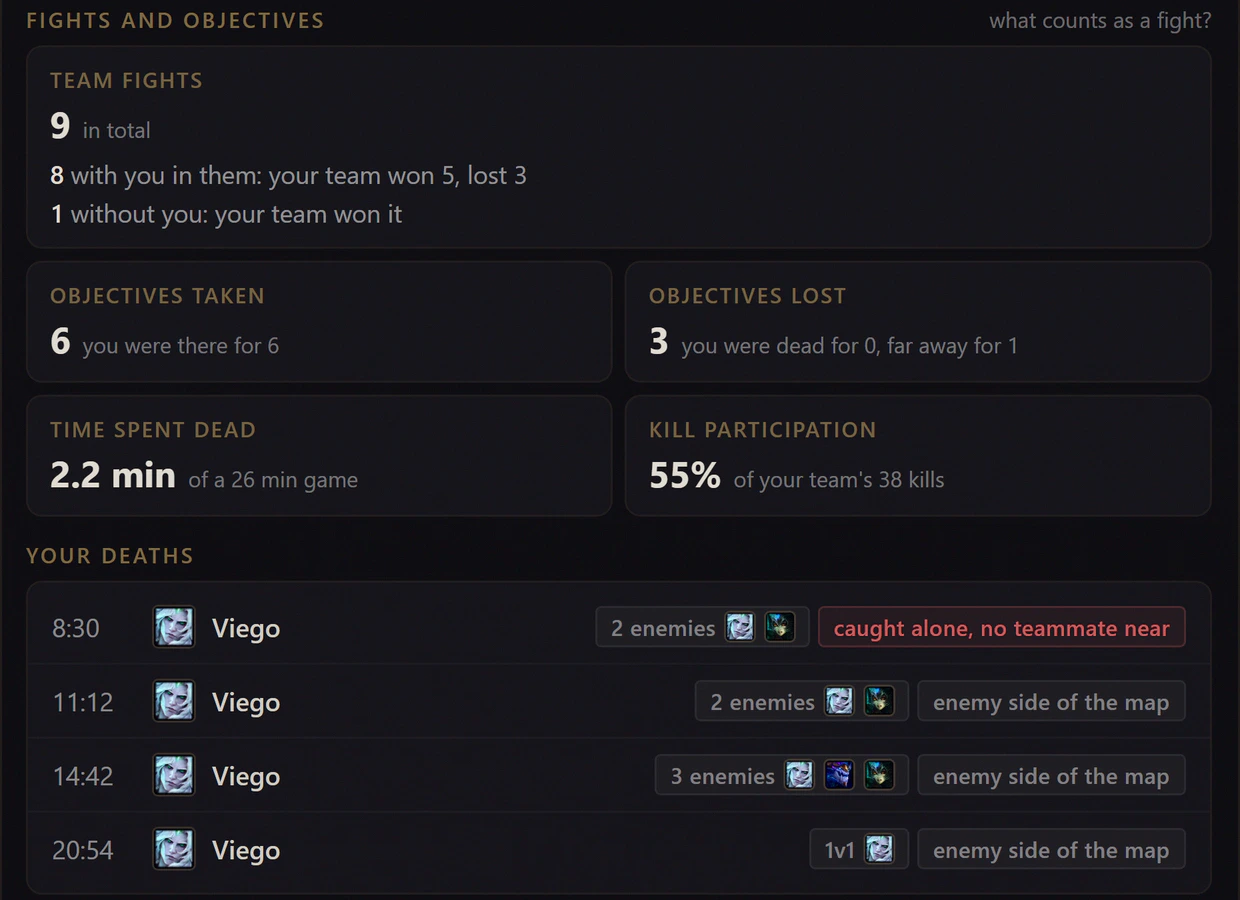
Below that, every death, one row each: the minute, who killed you, every enemy involved, and a tag that says whether you were caught alone with no teammate near or died on the enemy side of the map. Four deaths to Viego, three of them on his side of the map, tells a jungler something specific about where the risk was that game.
Only What Mattered
The hardest part of a post-game tool is knowing when to say nothing. A breakdown only flags what genuinely moved the result. A small vision gap in a stomp stays a clean win. A loss that was not on you says so: the verdict will tell you the result was decided by your team, and the cards will be about the fights you were not in, not about your CS.
The AI is used for exactly that judgment call: given everything the timeline says, which two or three things actually decided this game, and for this role? It does not write the evidence. The minutes, the counts and the names come straight from the game, which is why every card can be checked against the replay.
How to Use It Without Overthinking It
- After a loss, open the breakdown before you queue again. Read the verdict and the first hurt card. That is the one thing to carry into the next game. Ignore the rest for now.
- After a win, read the hurt cards anyway. Wins hide leaks. The Yi game was won with 3,484 gold unspent; against a closer team that is the game.
- Watch for repeats. If "deaths on the enemy side of the map" shows up three games in a row, that is a habit, not variance. The highlight chips in your match history make the pattern visible without opening every game.
- Trust the "not on you" verdicts. Some games are lost in fights you were not part of. Knowing that is worth as much as knowing what you did wrong, because it stops you fixing something that was not broken.
Where it lives: click any ranked game in Hexgate's match history. Breakdowns are built in the background right after the game ends and stored, so opening one is instant. Games already in your League client's recent history get analyzed too, so the list is full from day one.
What It Costs
Match Breakdown is part of Hexgate Pro+: €9.99 a month, or €7.49 a month billed annually, and it includes everything in Pro (unlimited games, lane matchup scoring, OTP builds). It covers ranked Solo/Duo and Flex. The free tier and Pro still get the full in-game overlay; the breakdown is the one thing that is Pro+ only. Details are on the pricing section.
Frequently Asked Questions
Does the Match Breakdown use AI?
Yes. Hexgate uses AI to weigh the signals from the game and decide which ones actually changed the result. Every sentence on a card is still a fact from your game: the minute, the number, the enemies involved. The AI decides what deserves a card; it does not invent the evidence.
Which games get a Match Breakdown?
Ranked Solo/Duo and Flex games. Normals, ARAM and ARAM Mayhem are not analyzed. Games already in your League client's recent match history are analyzed as well, so the list fills with breakdowns as soon as you upgrade.
Is this the same as the Mobalytics GPI?
No. The GPI scores your skills across many games over time. A Match Breakdown explains one game: what hurt, what helped, and why the result went the way it did. If you want a long-term skill profile, Mobalytics is the tool; if you want to know what happened in the game you just lost, this is.
Is it allowed by Riot?
Yes. The breakdown is built from the match history and timeline that your own League client already holds. Hexgate does not modify game files, read game memory or automate anything, and it works within Riot's third-party tool rules.
See Why Your Last Game Went the Way It Did
Hexgate builds against the enemy team during the game and, with Pro+, explains the result after it. Install free, play a ranked game, then upgrade to Pro+ in the app and every ranked game you have played recently gets its breakdown.
Get Hexgate Pro+Download Hexgate free (3 games a day, no ads) · see a full example